Overcoming Destructive Beliefs, Feelings, and Behaviors: New Directions for Rational Emotive Behavior Therapy by Albert Ellis
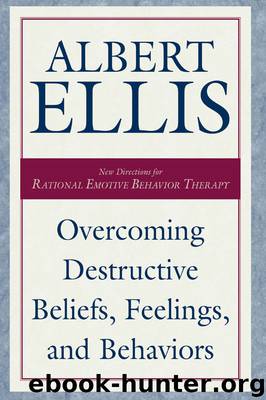
Author:Albert Ellis [Ellis, Albert]
Language: eng
Format: azw3, epub
Publisher: Prometheus Books
Published: 2010-05-01T04:00:00+00:00
* * *
This chapter is partly adapted from “Rational Emotive Behavior Therapy as an Internal Control Psychology,” International Journal of Reality Therapy 19 (1999): 4–11, and Journal of Rational-Emotive and Cognitive-Behavior Therapy 18 (2000): 19–38. Used with permission.
The term acceptance, which I am mainly referring to as accepting in this chapter, is an elusive term, as Haas (1994) pointed out in his comments on Hayes's (1994) and others’ use of it in the book, Acceptance and Change: Content and Context in Psychotherapy (Hayes, Jacobson, Follette, and Dougher 1994). Hayes himself (1994, p. 11) says that “acceptance is of different types, and not all of them are psychologically healthy.” Webster's New World Dictionary, if anything, adds to this confusion by defining acceptance as “1. An accepting or being accepted. 2. Approving reception; approval. 3. Belief in; assent.” And it defines accept as “to receive favorably; approve.”
This dictionary definition is particularly unhelpful in psychotherapy because we often try to help clients accept behaviors that they disapprove of but can't change, and to accept their feelings simply because they exist, without necessarily approving or disapproving of them.
How, then, can we accurately define accepting when it has several different, and sometimes contradictory, meanings? Not very precisely! However, let me try to mention several forms of accepting or nonjudging that have been commonly advocated by several philosophers—such as Gautama Buddha, Lao-Tsu, Jesus, and Martin Buber—as well as by a number of therapists—such as Carl Rogers, Fritz Perls, and myself. According to these writers, it is important for people to have several kinds of accepting:
To accept yourself unconditionally, even though you have many failings.
To unconditionally accept other people with their shortcomings. To accept the sinner but not the sin.
To accept the grim conditions of life when they cannot be changed.
To accept your dysfunctional feelings when you cannot change them.
To accept present restrictions and pains when they will produce future gains.
To accept the fact that your past history cannot be changed but your present reactions to it can be.
To accept your biological and socially learned limitations and not demand that they do not exist.
To accept your ultimate death, even if you would like to live forever.
To accept your and other people's fallibility and imperfection, to give them and you the right to be wrong.
To accept that you can change your thoughts, feelings, and behaviors—but usually only with much work and practice.
To accept that few things are wholly good or wholly bad. They are good and bad for a given purpose at a given time under certain conditions.
To accept that you and other people are often easily disturbable, and without trouble can act quite unreasonably and upsetting. Consider the source! Accept others with their self-upsetting.
Download
Overcoming Destructive Beliefs, Feelings, and Behaviors: New Directions for Rational Emotive Behavior Therapy by Albert Ellis.epub
This site does not store any files on its server. We only index and link to content provided by other sites. Please contact the content providers to delete copyright contents if any and email us, we'll remove relevant links or contents immediately.
| Administration & Medicine Economics | Allied Health Professions |
| Basic Sciences | Dentistry |
| History | Medical Informatics |
| Medicine | Nursing |
| Pharmacology | Psychology |
| Research | Veterinary Medicine |
The Art of Thinking Clearly by Rolf Dobelli(10598)
The 5 Love Languages: The Secret to Love That Lasts by Gary Chapman(9899)
Mindhunter: Inside the FBI's Elite Serial Crime Unit by John E. Douglas & Mark Olshaker(9419)
Becoming Supernatural by Dr. Joe Dispenza(8277)
Nudge - Improving Decisions about Health, Wealth, and Happiness by Thaler Sunstein(7758)
The Road Less Traveled by M. Scott Peck(7662)
Mastermind: How to Think Like Sherlock Holmes by Maria Konnikova(7429)
Enlightenment Now: The Case for Reason, Science, Humanism, and Progress by Steven Pinker(7354)
Win Bigly by Scott Adams(7256)
The Way of Zen by Alan W. Watts(6670)
Factfulness: Ten Reasons We're Wrong About the World – and Why Things Are Better Than You Think by Hans Rosling(4789)
The State of Affairs by Esther Perel(4764)
Gerald's Game by Stephen King(4708)
Man's Search for Meaning by Viktor Frankl(4669)
The Confidence Code by Katty Kay(4310)
Thinking in Bets by Annie Duke(4275)
The Healing Self by Deepak Chopra(3633)
Hidden Persuasion: 33 psychological influence techniques in advertising by Marc Andrews & Matthijs van Leeuwen & Rick van Baaren(3598)
The Worm at the Core by Sheldon Solomon(3512)
